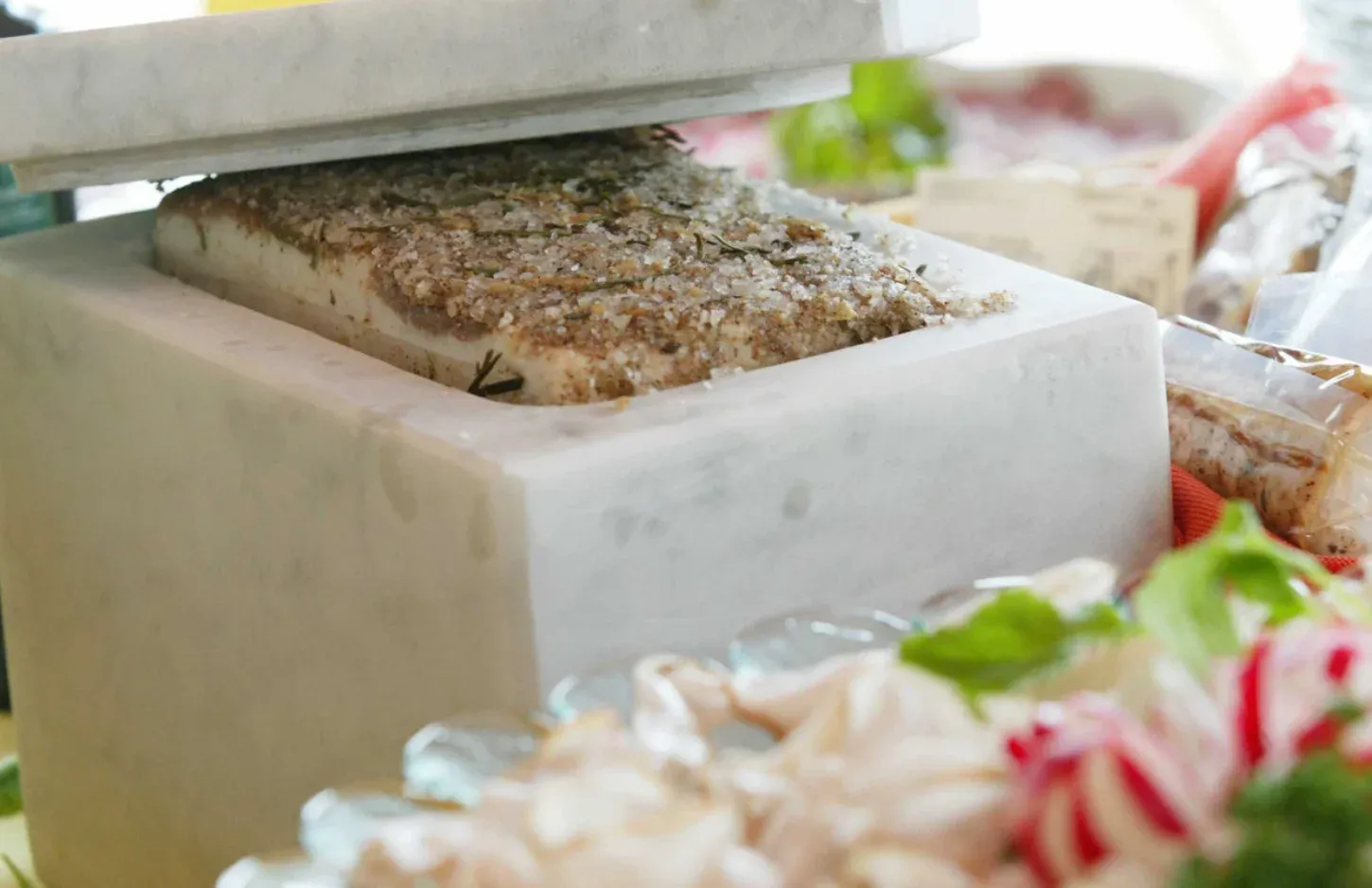
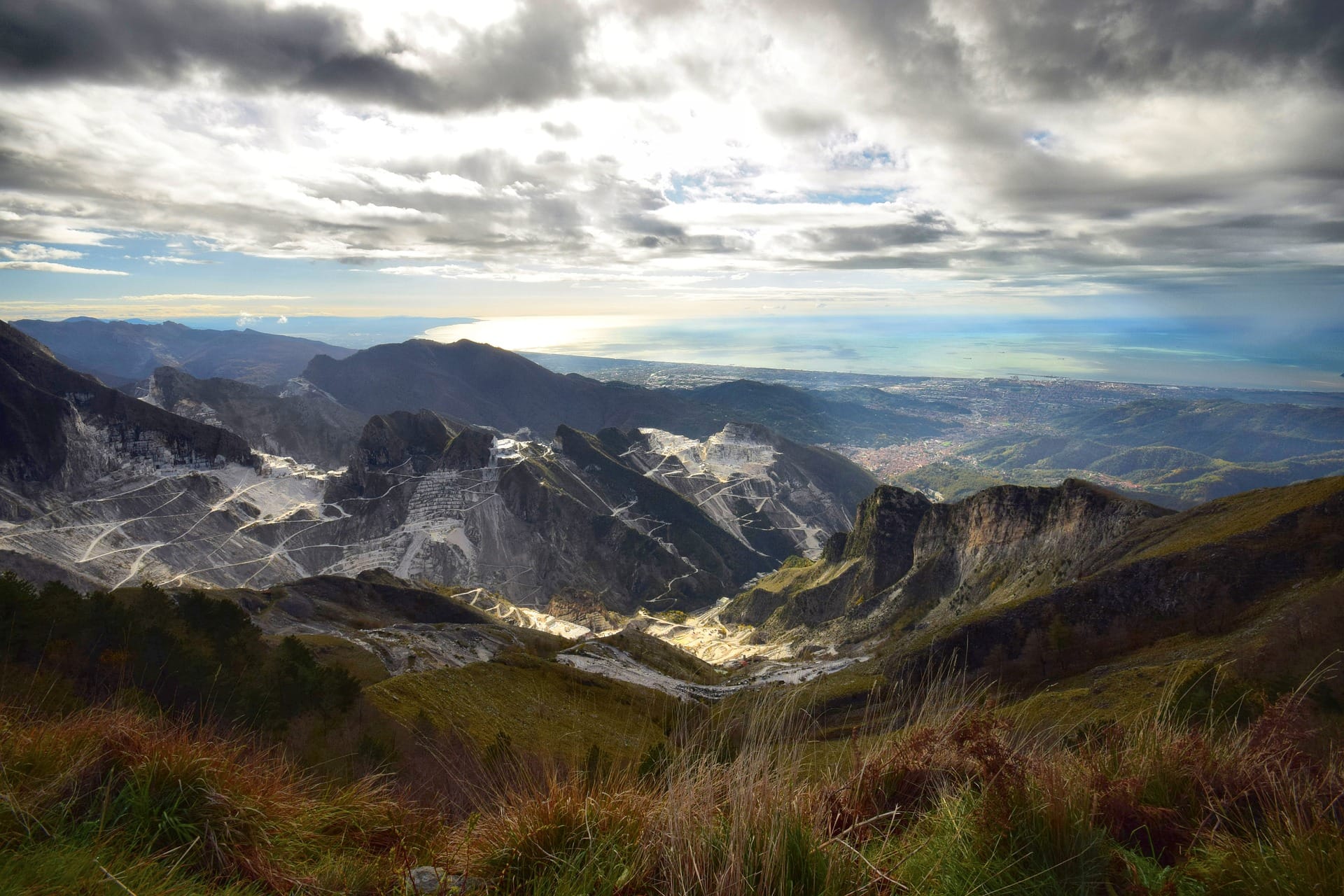
Colonnata is a hamlet of two hundred people in the Apuan Alps, a few kilometres from Carrara. No Michelin-starred restaurants, no famous chefs. What it has is white marble visible from the road and lard curing in stone cellars below.
Drive in and the quarries hit you first. The cliff faces catch the light at odd angles, almost too bright, the kind of white that makes you squint even in winter. Down in the village, the larderie keep their doors half-open. Stacked marble basins, the smell of rosemary and raw garlic hanging in the air, a coolness that doesn't belong to the season.
The quarries and the lard are not two separate stories. They are the same story: one about hard physical labour and the food that made it survivable, and how that food ended up on the menus of restaurants that the men who invented it would never have walked into.
The Oldest Story in Colonnata
Like many food products, the exact origins of lardo di Colonnata are hard to pin down. What survives is a mix of historical record and local legend, and the two are not always easy to separate.
Some accounts trace the name Colonnata back to a Roman slave colony established to work the marble quarries nearly two thousand years ago. It is plausible that the practice of curing pork in this valley dates to the same period. The Romans understood very well what fat could do for a body under physical strain. Roman legionaries, as recorded in the Justinian Code, received a ration of lard every three days.
The tradition carried forward through the Lombard period, when pig farming across the Apuan slopes received a new push, helped in part by the dense chestnut forests covering the hillsides. The trees fed the pigs through autumn, fattening them on fallen fruit before the seasonal slaughter.
Whether the local practice of curing lard in marble basins originated with the Celts, the Romans, the Lombards, or the medieval communes is a question nobody can answer with certainty. What is certain is that it is old. Marble conche found in the village have been dated to the seventeenth, eighteenth and nineteenth centuries, which puts the tradition well beyond living memory.
Then there is the story of Michelangelo. He came to Colonnata often, climbing up from Carrara to select blocks of statuary marble from the Canaloni quarries. The legend says he never left empty-handed. Beyond the marble, he would take back a wheel of lard, cured in the stone basins of the village. No document confirms it. But the story has persisted for five centuries, and that persistence says something about the reputation this product had already built during the Renaissance, when Colonnata was a necessary stop for anyone who worked with Carrara stone.
How the Lard Is Made
The production rules for Lardo di Colonnata IGP, registered by the European Commission in 2004, leave little room for interpretation. The process is seasonal, running from September through May. The fat must be worked fresh, within 72 hours of slaughter. That window is fixed.
The raw material is the dorsal fat of the pig, the adipose layer that runs from the back of the neck down to the rump. Before filling, each marble basin is rubbed with raw garlic. This is not ceremonial. It conditions the surface of the stone and becomes part of the curing process itself.
The lard is layered with a mix of sea salt, rosemary, crushed garlic, black pepper, cloves, nutmeg and cinnamon. Every producer keeps their own proportions, but the structure is the same. Once filled, the basin is sealed with a marble slab and left to rest in low-ventilation rooms, where humidity depends entirely on natural conditions.
The minimum curing time is six months. During this period the lard releases a natural brine, a liquid formed by prolonged contact with the salt, which producers monitor throughout the maturation. The microclimate of Colonnata, noted in the IGP registration in the Official Gazette, is described as conditions that cannot be replicated elsewhere: high ambient humidity, moderate summer temperatures, limited thermal variation.
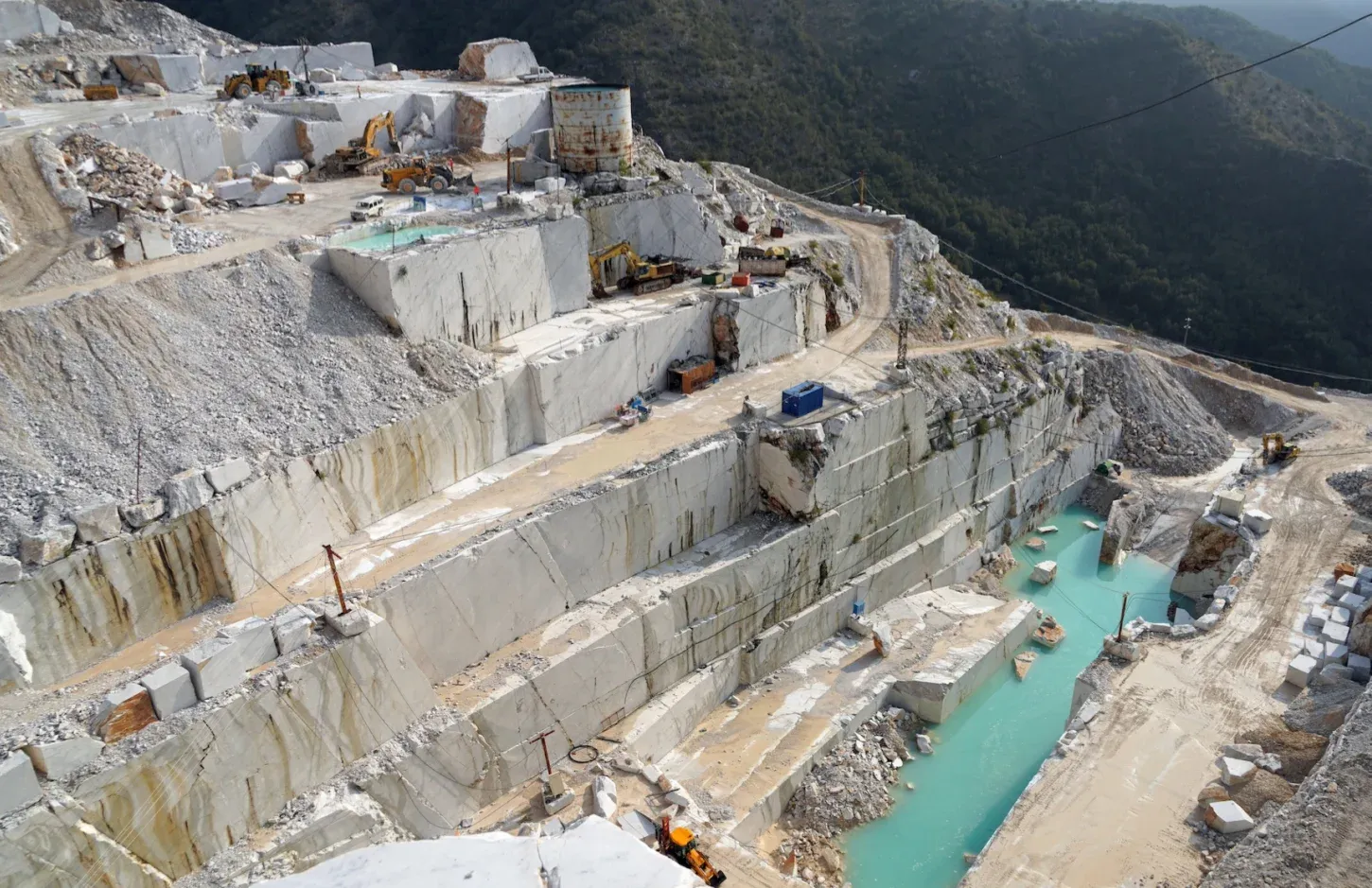
The marble basins must come exclusively from the Canaloni quarry, adjacent to the village. This is not a romantic detail. The stone extracted from that specific basin has a porosity that regulates moisture and temperature during curing in a way no other material, and no other marble, can reproduce.
The Fight That Made It Famous
For decades, lardo di Colonnata remained an almost secret product. People ate it in the village, quarry workers brought it home, and from the 1970s onwards a small stand in the square sold it to anyone who passed through. Outside Colonnata, few knew what it was. Nobody was looking for it.
The turning point came in the summer of 1996, and it came in the form of a seizure. Health authorities moved against several batches of production: the marble basins did not meet standard hygiene regulations for food preservation, and no rules existed yet to govern the production cycle or authorise its sale. The stone, naturally porous, could not be sterilised according to the parameters set for modern food industry.
What followed was a legal and media battle that nobody had anticipated. Chefs, journalists, food writers and producers took sides. The case reached the national press. For the first time, lardo di Colonnata crossed the boundaries of the village and became a matter of public debate, not as a folkloric curiosity but as a genuine cultural question. The seizures, paradoxically, marked a turning point: the product emerged from the legal limbo it had inhabited for centuries and began to acquire a defined set of rules.
It was in that climate that Slow Food brought lardo di Colonnata into the first Presidia established in Italy, in 2000. The recognition confirmed the cultural value of the product and opened the path to the institutional process that in 2004 led to the registration of the European IGP, with the Commission confining production to the municipality of Carrara and formally acknowledging the bond between the lard and its territory.
The threat of prohibition had turned out to be, without anyone planning it, the best marketing campaign Colonnata never paid for. The product had survived the bureaucracy. And in doing so, it had convinced the world it existed
How It Reached the World's Kitchens
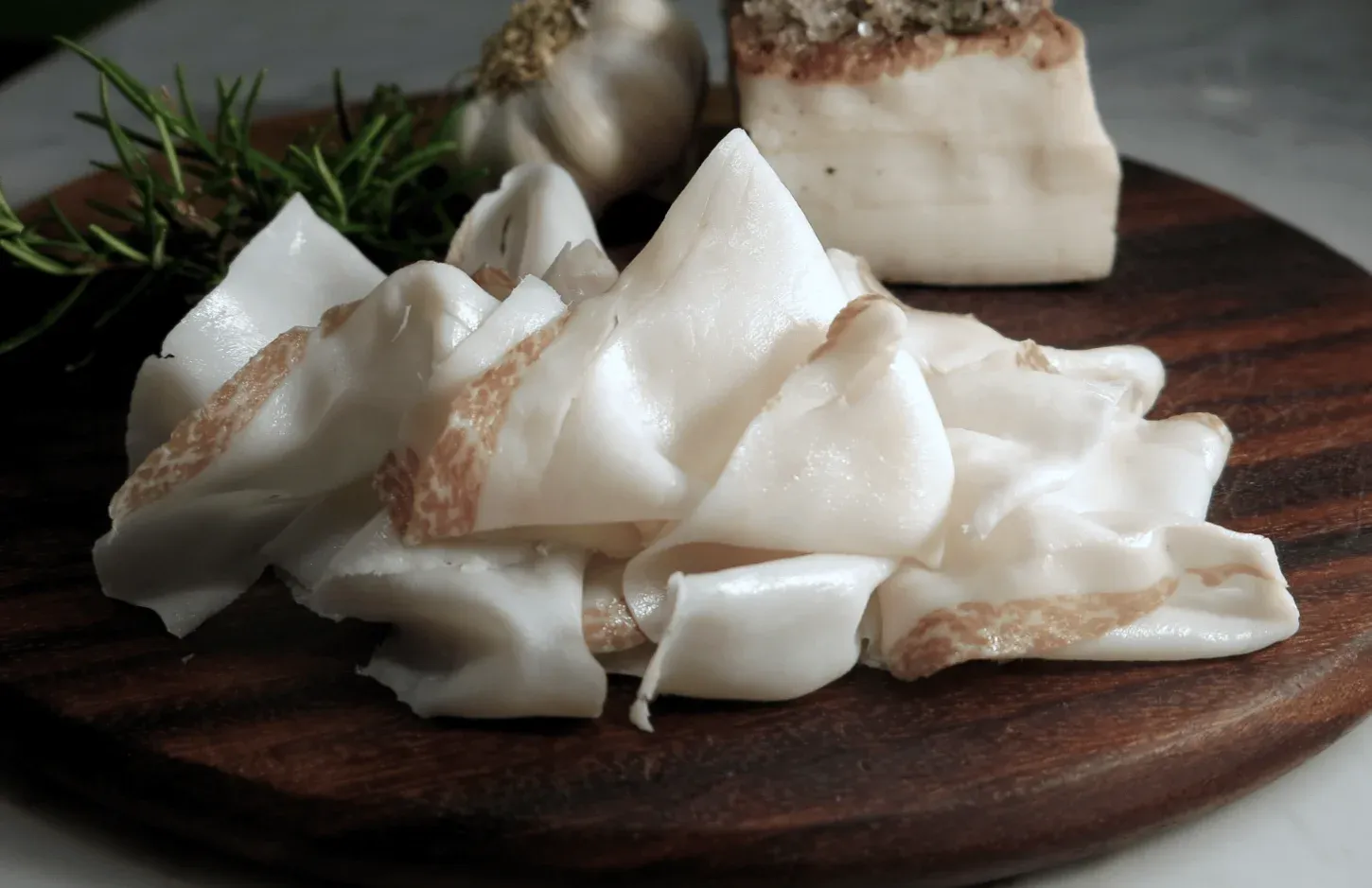
Il lardo di Colonnata ha un profilo organolettico che non assomiglia a nessun altro salume. Il colore è bianco candido, a volte con venature rosate nella parte più vicina alla cotenna. Al tatto è morbido, quasi cedevole. In bocca si scioglie prima ancora di masticarlo, rilasciando una grassezza pulita che non lascia residui pesanti, e poi arrivano le spezie: rosmarino, pepe, un fondo dolce e floreale che cambia leggermente da produttore a produttore.
Questa complessità aromatica è quello che ha attirato l'attenzione dei professionisti. Il lardo di Colonnata non va cotto, non va elaborato. Va solo affettato sottile, quasi trasparente, e posato su qualcosa di caldo, pane tostato, polenta appena fatta, un crostino. Il calore fa il lavoro: il grasso si scioglie lentamente, si distribuisce sulla superficie e trasforma un ingrediente semplice in qualcosa di difficile da spiegare a chi non lo ha mai assaggiato.
Fuori dall'Italia lo usano in modo diverso. Nei ristoranti fine dining europei viene impiegato per bardare tagli di carne magra prima della cottura, avvolto attorno al filetto o alla selvaggina per mantenere umidità e aggiungere profondità senza coprire il sapore della carne. Viene sciolto come base grassa al posto del burro, abbinato in chiave di contrasto a ingredienti dolci come fichi o pere, usato per rifinire un piatto al posto di una salsa.
In most of the food world, success is measured in volume. In Colonnata, it is not. The producers have remained local craftsmen, working with their own marble basins, often inherited. The scale has not grown. It is precisely this resistance to growth, deliberate or not, that has made lardo di Colonnata impossible to replicate and difficult to oversaturate. When a product cannot become large, it becomes rare. And in gastronomy, rare is worth more than large.
Frequently Asked Questions
What is Lardo di Colonnata?
Lardo di Colonnata is an Italian cured pork fat produced exclusively in Colonnata, a small hamlet in the Apuan Alps near Carrara, Tuscany. It is aged in marble basins carved from local Carrara stone and seasoned with sea salt, rosemary, garlic, black pepper and spices. It holds a European IGP certification since 2004.
What does Lardo di Colonnata taste like?
It has a delicate, clean fat flavour with sweet and floral notes from the spices used during curing. It melts at room temperature, releasing no heavy residue. The aromatic profile varies slightly between producers depending on their spice blend.
How is Lardo di Colonnata made?
The dorsal fat of the pig is layered with sea salt and spices inside marble basins, sealed with a marble slab and left to cure for a minimum of six months, in low-ventilation rooms where temperature and humidity are entirely natural. No preservatives or additives are used.
Why is marble used to cure Lardo di Colonnata?
The marble from the Canaloni quarry in Colonnata has a specific porosity that regulates moisture and temperature during curing. This cannot be replicated with other materials or with marble from other quarries. The basins must come exclusively from that source to meet IGP standards.
Is Lardo di Colonnata DOP or IGP?
Lardo di Colonnata holds an IGP, Indicazione Geografica Protetta, registered by the European Commission in 2004. This means production is geographically confined to the municipality of Carrara.
Where can you buy Lardo di Colonnata?
It can be purchased directly from producers in the village of Colonnata, from specialist Italian delicatessens, and from a growing number of online retailers. When buying, look for the IGP certification mark on the label.
How do you eat Lardo di Colonnata?
The classic way is sliced thin on warm toasted bread or polenta, where the heat melts the fat slowly across the surface. In fine dining it is used to bard lean cuts of meat, as a fat base in place of butter, or as a finishing element paired with sweet ingredients like figs or honey.
What is the Slow Food Presidium for Lardo di Colonnata?
In 2000, Slow Food included Lardo di Colonnata among the first Presidia established in Italy, recognising its cultural and gastronomic value at a time when its production was under threat from European hygiene regulations.