
The Flower Behind the Spice
Crocus sativus does not exist in nature without human intervention. It is a sterile plant, incapable of reproducing through seeds. Every year, growers must dig up the corms, underground organs similar to bulbs that store energy, divide them and replant them by hand. Without this work, the plant simply disappears.
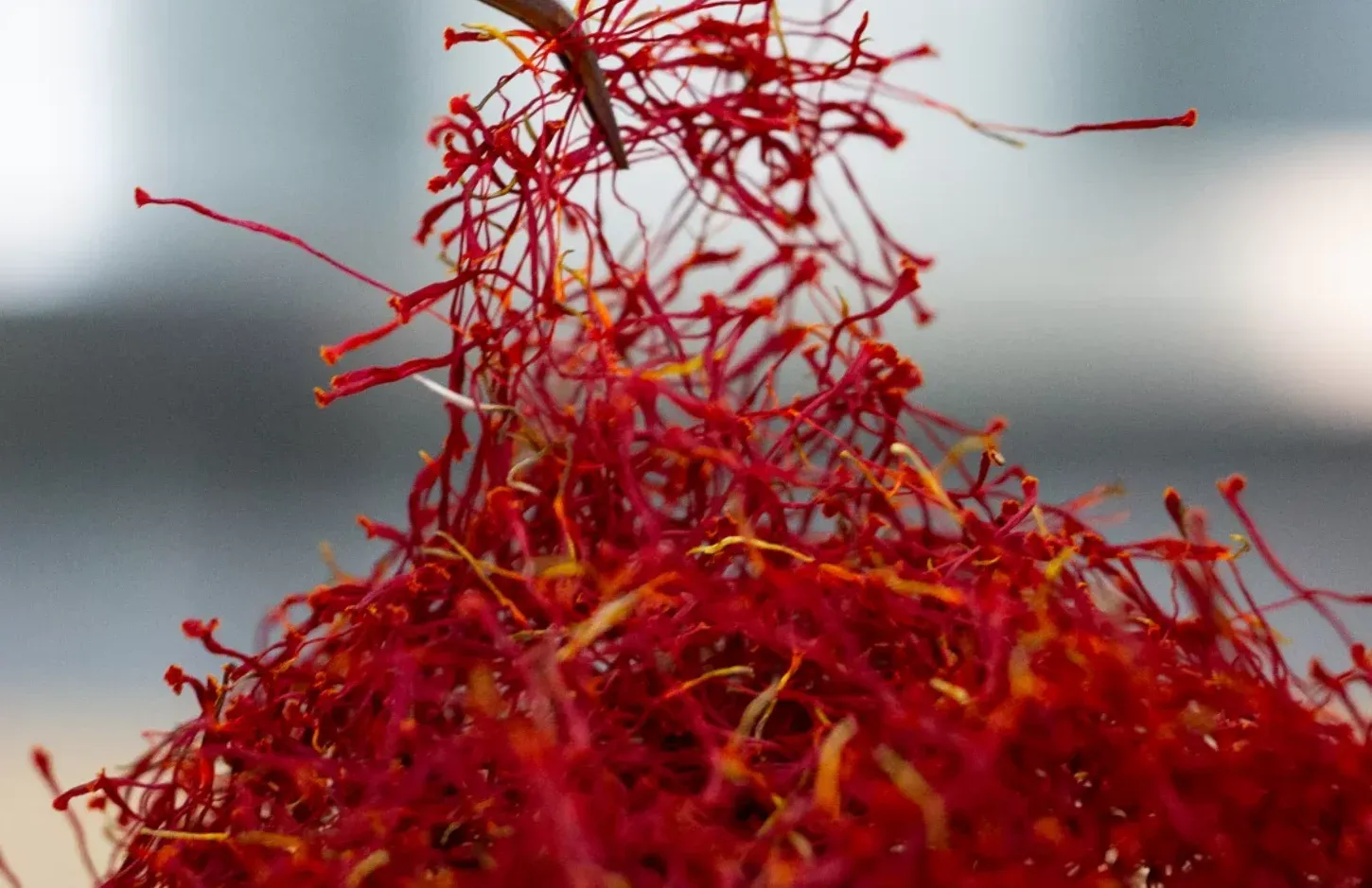
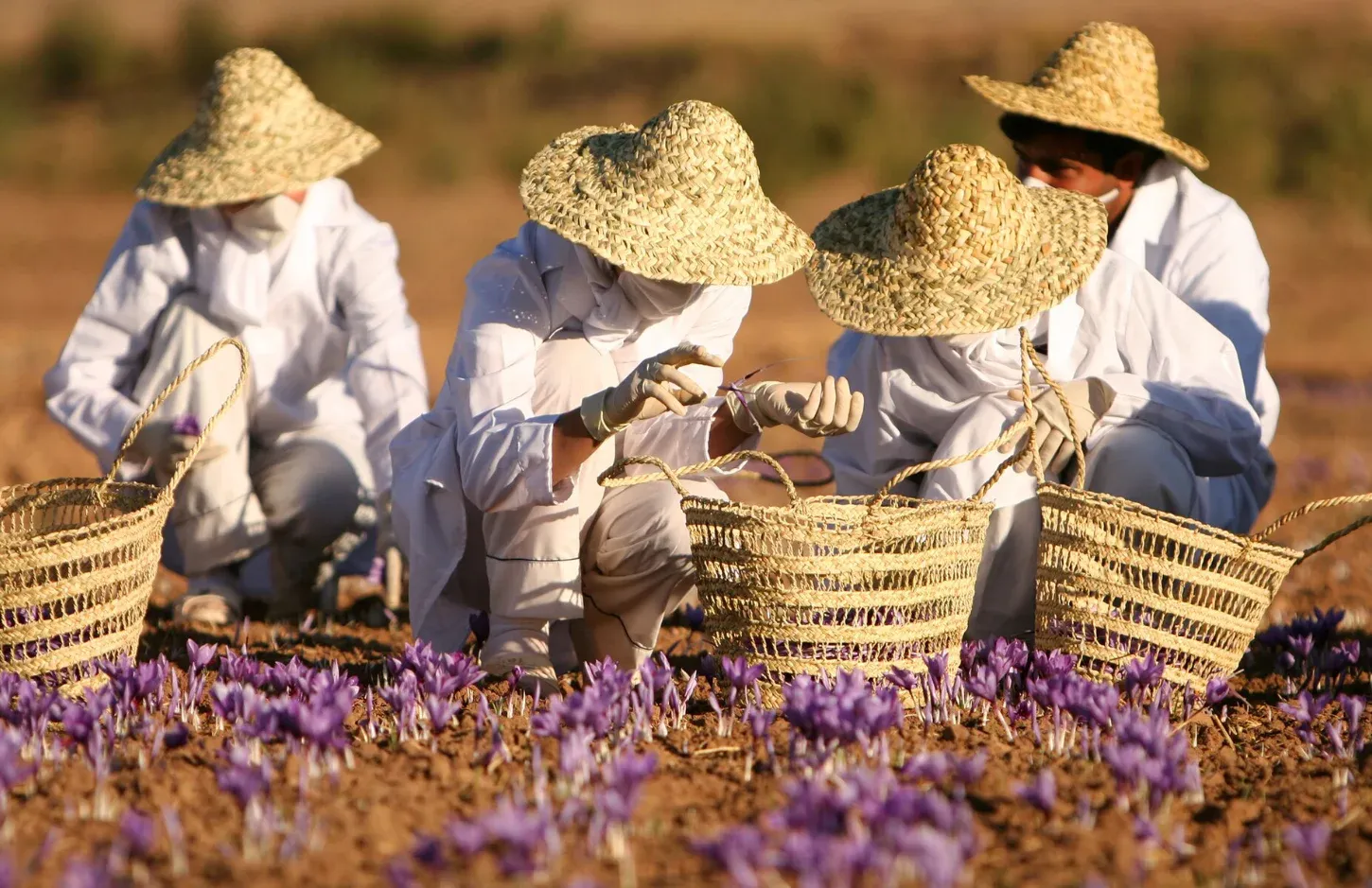
It blooms once a year, for two weeks in autumn. The flowers are violet, delicate, and last only a matter of hours: if they are not harvested shortly after blooming, they wither and take their stigmas with them. Each flower produces three red stigmas, which must be collected at dawn, before the sun begins to degrade the aromatic compounds.
That is where everything concentrates: over 150 volatile compounds, carotenoids such as zeaxanthin and lycopene, and above all crocin, the pigment that gives saffron its unmistakable yellow-orange color. Crocin is water-soluble, it does not dissolve in fats, and this detail changes the way it should be used in cooking.
Three Thousand Years, Same Technique
Saffron has been cultivated for at least 3,700 years. The earliest known representations are Minoan frescoes from 1600 BC, found on Santorini, showing figures harvesting the flowers. Genetic studies published in 2019 confirmed that Crocus cartwrightianus, the wild relative closest to the cultivated plant, grows only in mainland Greece: that is most likely where domestication began.
From those first fields, the plant moved east. The Persians were growing it in Isfahan as early as the 10th century BC, and with Alexander the Great, Persian saffron reached India and Central Asia. By 100 BC it had arrived in China. The fall of Rome interrupted cultivation in Europe, and it was the Arab conquest of Spain in the 7th century that reintroduced it to the continent.
The word itself is evidence: “azafrán” comes from the Arabic al-za’farān, which in turn derives from the Persian za’ferân. It reached Italy in the 13th century, when a Dominican friar from Abruzzo smuggled bulbs out of Spain and started what would become the cultivation of Navelli.
The logic of cultivation has not changed since then. The corms are planted in summer, between July and August, in well-drained, sunny soil. The flowers bloom in autumn, between October and November, and harvesting must happen at dawn, before the heat fully opens the flower and triggers the degradation of the aromatic compounds. Each stigma is separated from the flower by hand, then dried quickly, usually with moderate heat, to stop moisture and concentrate the active compounds.
To obtain one kilogram of dry saffron, between 150,000 and 200,000 flowers are needed. Each flower must be picked individually, the three stigmas separated one by one, and the entire operation must be completed within a few hours of dawn. An experienced worker collects between 60 and 80 grams of fresh stigmas per day, which after drying reduce to around 12 grams of finished product. No machine has yet replaced human hands at any stage of this process.
Where It Grows
The global saffron map is, in practice, a map of Iran. In 2005, a study by Ferdowsi University of Mashhad put the country’s output at 230 tonnes, representing 93.7% of total world production, across more than 50,000 cultivated hectares in Khorasan, Fars and Kerman. But that dominance comes with a structural distortion: 90% of Iranian saffron leaves the country in bulk, unbranded.
Spain imports 56 tonnes a year, repackages between 40% and 50% of it, and ships it back out under a European label. “Saffron from Spain” is, in most cases, Iranian saffron repacked in Valencia.
Spain does have its own production, and it is worth distinguishing. The PDO Azafrán de La Mancha, EU-recognized since 2001 and covering Albacete, Cuenca, Toledo and Ciudad Real, traces a very different trajectory: from 141 tonnes at the start of the twentieth century to 1.1 tonnes in 2023. What survives is genuine and traceable, its aromatic profile shaped by altitude and the sharp seasonal swings of the Castilian plateau.
Italy’s three PDOs occupy a similar niche, each with a longer memory. Zafferano dell’Aquila grows on the Navelli plateau in Abruzzo, on the same terraces cultivated since a Dominican friar introduced the crop in the 13th century.
Zafferano di San Gimignano goes back further still: a 1221 document records its export to Alexandria and Tunis, when Tuscany was already trading the spice across the Mediterranean.
Zafferano di Sardegna, EU-recognized since 2009, comes from the Medio Campidano, where cultivation has deep roots in local agricultural tradition. All three remain small, artisanal operations with no ambition beyond the premium market.
The American chapter is less known and structurally separate. German and Alsatian settlers brought Crocus sativus to Pennsylvania in the 18th century; today, a stretch of Lebanon, Lancaster and Berks counties is still referred to as the Saffron Belt. High labor costs kept commercial production from scaling, and the trade survives mostly through Mennonite families in Berks County selling at local markets.
The University of Vermont’s North American Center for Saffron Research and Development, opened in 2015, is the first institution on the continent dedicated to the crop, a sign that academic interest is running well ahead of the industry.
In the Kitchen
Saffron is one of those ingredients people mishandle out of overconfidence. The first thing to do, and almost no one does it right the first time, is never add it directly to a dish. It needs to steep in a warm liquid, water, stock, milk, or white wine, for at least 20 minutes. Excessive heat degrades safranal, the compound responsible for the aroma: the color stays, but the depth disappears. Crocin, the pigment, is water-soluble and does not dissolve in fat, so adding it to oil or butter is a mistake you can see and smell. The dose is 0.1/0.2 grams per serving: beyond that threshold the flavor turns bitter, and given that a gram costs between 5 and 10 euros, it is not an economically neutral mistake.
The geography of saffron dishes is wider than most people expect, and it often surprises by the directions it takes. In Italy the canonical reference is risotto alla milanese, with bone marrow and Parmigiano. In Spain it goes into paella valenciana alongside smoked paprika. So far, nothing surprising. More interesting is the role it plays in France in Marseille's bouillabaisse, where it works alongside fennel and orange zest in a balance that does not tolerate approximations. In Iran it is one of the structural ingredients of everyday cooking: in tahdig, the golden crispy rice crust, and in joojeh kabab, the chicken marinated with lemon juice, where saffron is not decoration but a central part of the aromatic profile. In the Indian subcontinent it appears in biryani and in kheer, the spiced rice pudding of festive occasions, two very different contexts that share the same logic: saffron as a marker of something worth celebrating.
The most reliable pairings are with animal fats, butter, bone marrow, cream, which amplify its gustatory presence even without dissolving it chemically. It works well with citrus, honey, cardamom, and rose water. It holds up well against marine flavors, shellfish and white fish in particular. The spices to keep at a distance are the high-intensity ones: cinnamon in generous doses or strong chili do not balance with saffron, they simply bury it. It is one of the rare spices that gains nothing from the wrong company.
Real or Fake
The simplest test uses a glass of cold water. Drop a few threads in and watch: real saffron releases color slowly, over 10 to 15 minutes, gradually shifting toward orange. If the water turns red within seconds, the pigment has been added artificially. Smell is another reliable indicator: it should be metallic and honey-like, with a slightly bitter edge. Saffron that smells only of hay has been poorly stored or adulterated.
Iranian grading divides into three main categories. Sargol consists only of the red tips of the stigmas and represents the highest grade. Pushal includes the full stigma with the yellow base attached. Bunch, also called Daste, is the stigma still connected to the white style of the flower, the lowest grade.
The reference standard is ISO 3632, which classifies saffron into four categories based on the concentration of crocin, picrocrocin and safranal. The problem is that compliance is voluntary and retail-level controls are limited. A 2012 study found that more than 40% of saffron samples purchased across Europe did not meet the ISO 3632 category declared on the label.
Three stigmas per flower. One harvest per year. No shortcuts at any stage. The price of saffron is not a mystery once you understand the plant.
FREQUENTLY ASKED QUESTIONS
Is saffron really more expensive than gold?
By weight, yes, in most market conditions. High-grade saffron sells between 5,000 and 10,000 euros per kilogram at retail. The comparison holds, though it depends on the gold price at any given moment. The more relevant point is why: between 150,000 and 200,000 flowers, harvested by hand over two weeks, to produce one kilogram.
Why does saffron turn food yellow and not red?
The threads are red, but the pigment they release, crocin, produces a yellow-orange color in water. Crocin is a carotenoid, chemically similar to the compounds that color carrots and egg yolks. The red of the stigmas is visible only before infusion.
Can I use saffron powder instead of threads?
Powder is harder to authenticate and easier to adulterate. Threads allow you to run a basic quality test before use. If you buy powder, make sure it comes from a traceable source with ISO 3632 certification.
How should I store saffron?
In an airtight container, away from light and heat. A cool, dark cupboard works. The refrigerator introduces humidity, which accelerates degradation. Properly stored, saffron retains its aromatic profile for up to two years.
What is the difference between Spanish and Iranian saffron?
In most cases, none: the majority of saffron sold under a Spanish label is Iranian saffron repackaged in Spain. Genuine PDO Azafrán de La Mancha is a distinct product, traceable and certified, but production has dropped to around 1.1 tonnes per year. If the price seems low for "Spanish saffron," it is almost certainly Iranian.
How much saffron do I actually need per dish?
Between 0.1 and 0.2 grams per serving. For a risotto for four, that is roughly 0.4 to 0.6 grams. At retail prices, the ingredient cost per portion is between 0.50 and 1.50 euros, making it one of the most cost-efficient premium ingredients in professional cooking.