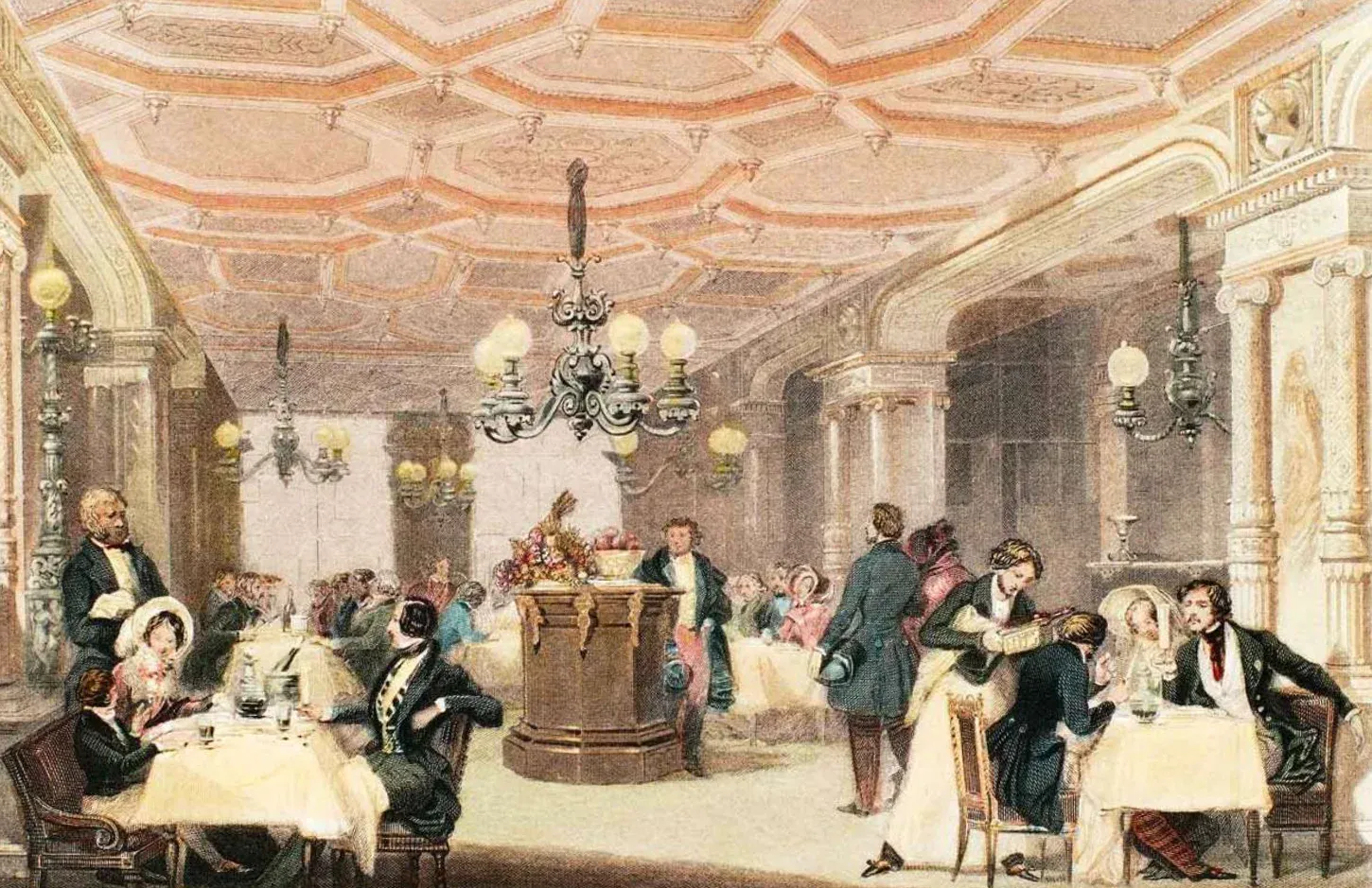
Restaurant before restaurant
In late eighteenth-century Europe, eating outside the home was something you did out of necessity: travelers, laborers, people without a kitchen. Cities had no shortage of places to eat, but each one served a narrow, specific purpose.
Taverns sold wine, the vin à pot, with food as an afterthought. Cabarets worked the same way. Auberges offered one meal a day: one dish, one time slot, one shared table. Traiteurs sold ready-made sauces and stews to take away; some ran a table d’hôte, where diners sat together at a fixed hour and ate whatever was on offer.
The communal meal was the standard. Dishes arrived at the table covered, already set out before the diners walked in. Anyone seated at the far end made do. Food was often cold. The clientele was almost entirely male, and wine remained the main reason to walk through the door.
The aristocracy and upper bourgeoisie ate at home, their own or someone else’s. Taverns were for carters, inns for traveling merchants. It was only in the Napoleonic era that the urban middle class began approaching dining out as a social act, pushed along by the food press and the first refined establishments that were quietly remaking Paris.
Boulanger and the First Menu
In 1765, on rue des Poulies in Paris, a man named Boulanger wrote a phrase above his door in Latin: Venite ad me, omnes qui stomacho laboratis, et ego restaurabo vos. Come to me, all who suffer in the stomach, and I will restore you. He served broths and consommés, sold at the time as medicinal foods rather than proper meals. But Boulanger did something no one had done before: individual tables, a written menu.
It was not yet a restaurant in the modern sense. It was, however, a break. The traiteurs, the guild that held a monopoly over cooked meats and stews, took him to court. They argued that his dish, a ragout of sheep’s trotters in white sauce, violated their exclusive rights. The court ruled in his favor. That ruling cracked open the guild system that the Revolution, twenty years later, would finish off entirely.
The Revolution Set the Chefs Free
The French Revolution dismantled the monarchy, the guilds, the noble households, and the kitchen staffs that ran them. Thousands of cooks who had worked for the aristocracy found themselves without employers within the space of a few years. Some left France. Others opened a restaurant.
The result was an explosion. Paris had fewer than a hundred restaurants in 1789. By 1800, there were several hundred. Cooks trained in the great noble houses brought into the dining room techniques, recipes, and standards of service that no paying public had ever encountered before. For the first time, anyone with enough money for a meal could sit down, order from a menu, and be served like an aristocrat.
The restaurant reshaped the social geometry of the city. Money replaced rank, and a person could eat what they wanted, when they wanted, without owing anything to anyone.
Choosing What to Eat Was a New Idea
In 1803, Alexandre Balthazar Laurent Grimod de La Reynière published the first issue of the Almanach des Gourmands. It was the first restaurant guide in history: eight volumes, one per year until 1812, written to orient a Parisian bourgeoisie that filled the new restaurants without knowing, in Grimod’s view, how to tell a good meal from a bad one.
In 1808 he followed it with the Manuel des Amphitryons, a handbook on the art of hosting and carving meat. These texts put the word “gastronomy” into circulation for the first time.
Twenty years later, in 1825, Jean Anthelme Brillat-Savarin published La Physiologie du Goût, a few months before his death. The book wove together sociology, anthropology, and sensory experience around the table, drawing a clear line between the pleasure of eating, a physiological need, and the pleasure of the table, made of conversation, company, and context.
Gourmandise became “a passionate, reasoned and habitual preference for everything that pleases the palate” and one of the strongest social bonds in existence.
At the same time, the menu was changing its purpose. The word had existed since 1761, but it described the list a head cook prepared for the household.
In the Parisian restaurants of the early nineteenth century, as service shifted from the French style, all dishes presented at once, to the Russian style with courses arriving in sequence, the menu became a document handed to each individual diner.
For the first time, a person sitting at a restaurant table could read, consider, and choose before anything arrived.
The Restaurant Goes Global
The Parisian model did not stay in Paris for long. Throughout the nineteenth century, cooks and maîtres d'hôtel trained in the great French dining rooms carried written menus, individual tables, and Russian-style service to the European capitals that wanted to compete with Paris.
London, Vienna, Milan opened structured establishments on the French model.
The restaurant became a marker of urban modernity: a city worth its name had at least one.
In the United States, the shift came from a family of Swiss-Italian emigrants. Giovanni and Pietro Delmonico opened a small pastry shop in 1827 at 23 William Street in New York, near Wall Street, selling French pastries, wine, Cuban cigars, and hot chocolate.
In 1837, their nephew Lorenzo Delmonico took over the culinary side and turned the place into something America had never seen before: a written menu, a wine list, a structured dining room, European-level cooking.
Delmonico's became the first fine dining restaurant in the United States, frequented by presidents, writers, and Gilded Age tycoons.
It was also the first American establishment to allow women to dine without a male escort, a detail that shows how much the restaurant was rewriting the rules of public space. Its kitchen produced dishes that entered American culture permanently: the Delmonico Steak, Eggs Benedict
The growth of industrial cities did the rest. A middle class with disposable income and leisure time needed places to meet, be seen, and eat well. By the end of the century, the restaurant had stopped being a specifically French invention and become a global urban format.
The founding principle remained Boulanger's: a menu, individual choice, a table of your own.
In two hundred years the restaurant has changed shape many times: from the dining room to the delivery app, from the pop-up to the chef’s table. The global market is worth over 3.5 trillion dollars today. The logic, though, has stayed the same since Boulanger: a space where the customer chooses, orders, and pays for what they want.
Frequently Asked Questions
What did people eat outside the home before restaurants existed?
Food was served in taverns, inns, and cabarets with no menu. Meals were communal, served at fixed hours, with a single dish available. Individual choice was not part of the experience.
Who invented the modern restaurant?
The first establishment with individual tables and a written menu is attributed to Boulanger, who opened in Paris around 1765. He served broths and consommés as medicinal foods, but introduced for the first time the possibility of choosing what to eat.
What role did the French Revolution play in the spread of restaurants?
The Revolution dismantled the guilds and dissolved the great noble households. Thousands of cooks who lost their positions opened their own establishments. Paris went from fewer than a hundred restaurants in 1789 to several hundred by 1800.
Who was Grimod de La Reynière and why does he matter?
He was the author of the Almanach des Gourmands (1803), the first restaurant guide in history. He was the first to review restaurants systematically and to use the word "gastronomy" in its modern sense.
What did Brillat-Savarin contribute to food culture?
With La Physiologie du Goût (1825), he codified for the first time the pleasure of the table as a social and cultural act, distinct from the simple need to eat.
When did the first American restaurant open?
Delmonico's in New York, founded by Swiss-Italian emigrants, became in 1837 the first fine dining restaurant in the United States, with a written menu, a wine list, and European-level cooking.
How did the restaurant model spread beyond France?
Throughout the nineteenth century, cooks and maîtres d'hôtel trained in Paris brought the model to European capitals and beyond. The restaurant became a symbol of urban modernity ac